CyberHubs at the CYNERGY 2026
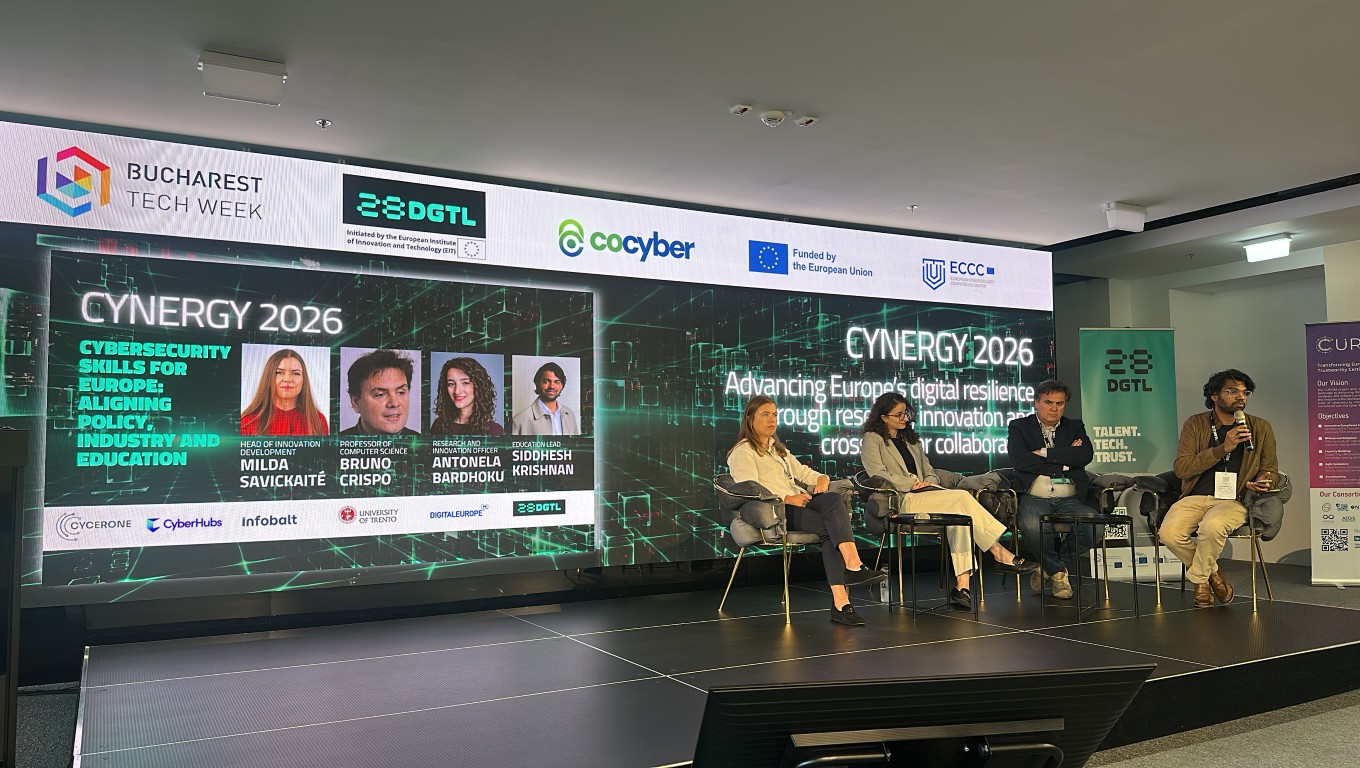
CyberHubs joined CYNERGY 2026, a flagship cybersecurity event organised by 28DIGITAL on 16 June in Bucharest, as part of the Bucharest Tech Week, bringing together leading researchers, policymakers, industry actors, and innovation stakeholdersworking for advancing Europe’s cybersecurity resilience.
Antonela Bardhoku from DIGITALEUROPE and Milda Savickaite from INFOBALT joined the panel session “Skills for Europe: Aligning Policy, Industry and Education” moderated by Siddhesh Krishnan from 28DIGITAL. The CyberHubs speakers mentioned that Europe is facing a growing cybersecurity challenge and cyber threats are becoming more sophisticated, while the shortage of skilled cybersecurity professionals continues to widen. Building and maintaining a well-trained workforce is therefore essential for Europe’s resilience, competitiveness and digital future.
They highlighted the focus of CyberHubs project on building a sustainable cybersecurity skills ecosystem across Europe through a network of seven national Cybersecurity Skills Hubs in Belgium, Estonia, Greece, Hungary, Lithuania, Slovenia and Spain. Each Hub bringing together a national digital association and a university or training provider. This model was designed to address one of the key challenges we identified: the gap between industry demand and the education and training offer.
By bringing together industry, academia and other national stakeholders, the Hubs work to identify skills needs, develop national strategies, raise awareness, build capacity and promote collaboration across the cybersecurity ecosystem. Importantly, the Hubs also cooperate at European level, exchanging best practices and learning from one another. The goal is not simply to deliver training, but to create long-term structures and partnerships that can continue beyond the project itself.
Some lessons were also shared from the project:
First, cybersecurity skills cannot be developed in silos. Sustainable skills ecosystems require close cooperation between industry, academia and public authorities to ensure that training remains aligned with rapidly evolving market needs.
Second, skills development must be continuous. Cybersecurity is a fast-moving field, which means that upskilling and reskilling cannot be one-off exercises but must become part of a lifelong learning culture.
Finally, sustainability comes from building ecosystems, not just delivering courses. By creating networks, partnerships and portal that endure beyond individual funding cycles, we can help ensure that Europe develops the cybersecurity talent it needs for the long term.
Among the main takeaways from the event were:
- Europe’s cybersecurity skills gap remains a major challenge for digital resilience, competitiveness, and strategic autonomy, requiring coordinated action across policy, industry, and education.
- Stronger collaboration between employers, training providers, universities, and policymakers is essential to ensure cybersecurity education reflects evolving labour market needs.
- Greater European cooperation can accelerate skills development by facilitating the exchange of expertise, resources, and best practices, to strengthening cybersecurity capabilities at both national and EU levels.
- Long-term success will depend on sustained stakeholder engagement, a culture of continuous upskilling and reskilling to keep pace with evolving cyber threats and technologies, and effective mechanisms for scaling successful initiatives and best practices across Europe.
Learn more about the event here.

Subscribe to our newsletter
Stay updated on the project’s news, events, free resources and more.
"*" indicates required fields